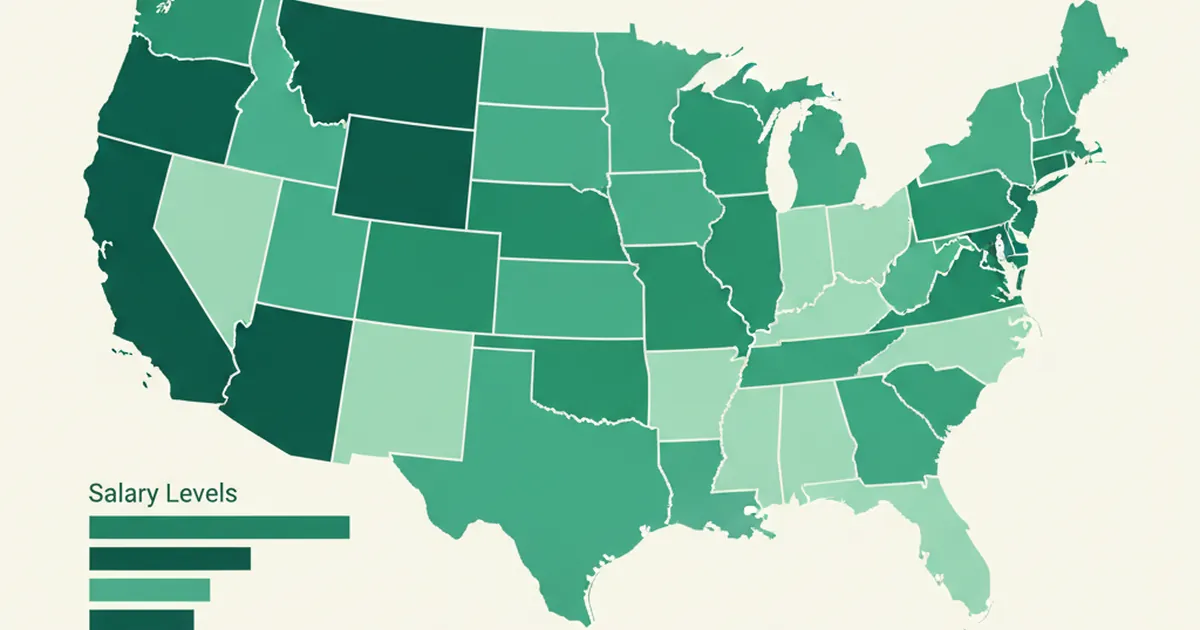
The national median salary for social workers is $61,780 per year, according to the Bureau of Labor Statistics. That number is useful as a benchmark, but it hides an enormous amount of variation. A social worker in Massachusetts earns a mean annual wage of $85,320, while a colleague doing comparable work in Mississippi averages $48,490. That is a $36,830 gap driven almost entirely by geography.
If you are a BSW student planning your career or an early-career social worker considering a move, state-level salary data should be part of your decision-making. Where you practice affects what you earn, what it costs you to live, how many jobs are available, and what specializations are in demand. This guide breaks down all of it using the most current BLS data available.
National Salary Overview
The BLS reports a median annual wage of $61,780 for social workers as of May 2025, based on data covering 810,900 employed social workers nationwide. That median sits well above the $49,500 median for all occupations.
But “social worker” is a broad classification. The BLS breaks the profession into four subcategories, each with its own wage profile:
| Specialization | Median Annual Wage | Employment |
|---|---|---|
| Social workers, all other | $71,900 | 81,000 |
| Healthcare social workers | $67,880 | 193,200 |
| Mental health and substance abuse social workers | $60,280 | 136,800 |
| Child, family, and school social workers | $59,550 | 399,900 |
Source: BLS Occupational Outlook Handbook, May 2025
The wage range across the profession is wide. The lowest 10% of social workers earn less than $42,790, while the highest 10% earn more than $100,090. At the 25th percentile, wages sit at $49,290; at the 75th, $74,600. This spread reflects differences in specialization, education level, setting, experience, and — critically — location.
The wage differences across industries tell a similar story. Social workers employed in educational services earn a median of $67,620, while those in local government earn $65,920. At the other end, social workers in individual and family services earn $51,430, and those in community food, housing, and emergency services earn $49,980. The gap between the highest- and lowest-paying major industries is nearly $18,000.
Highest-Paying States for Social Workers
The following table ranks every state by annual mean wage for social workers (SOC 21-1020), based on BLS Occupational Employment and Wage Statistics data for May 2025. Mean wages are used here because the BLS OES program publishes them consistently across all states, making direct comparisons possible.
Top 15 States by Annual Mean Wage
| Rank | State | Annual Mean Wage | Employment |
|---|---|---|---|
| 1 | Massachusetts | $85,320 | 27,590 |
| 2 | California | $80,030 | 78,380 |
| 3 | New York | $78,270 | 68,800 |
| 4 | Connecticut | $77,300 | 9,040 |
| 5 | New Jersey | $76,180 | 19,920 |
| 6 | Washington | $75,480 | 32,380 |
| 7 | Oregon | $74,760 | 15,400 |
| 8 | Alaska | $72,660 | 1,250 |
| 9 | Maryland | $69,840 | 17,410 |
| 10 | Hawaii | $69,320 | 1,510 |
| 11 | Wyoming | $68,480 | 1,380 |
| 12 | Rhode Island | $67,950 | 4,600 |
| 13 | Minnesota | $66,930 | 18,810 |
| 14 | Virginia | $66,440 | 26,910 |
| 15 | Delaware | $65,800 | 3,780 |
Source: BLS Occupational Employment and Wage Statistics, May 2025
Bottom 10 States by Annual Mean Wage
| Rank | State | Annual Mean Wage | Employment |
|---|---|---|---|
| 41 | Tennessee | $55,650 | 18,890 |
| 42 | Kansas | $55,180 | 6,480 |
| 43 | Missouri | $54,470 | 14,920 |
| 44 | Iowa | $54,450 | 8,690 |
| 45 | West Virginia | $52,840 | 7,730 |
| 46 | Nebraska | $52,670 | 5,080 |
| 47 | Arkansas | $50,890 | 6,780 |
| 48 | Mississippi | $48,490 | 7,160 |
Source: BLS Occupational Employment and Wage Statistics, May 2025
Several patterns stand out. The highest-paying states cluster along the coasts — particularly the Northeast and Pacific Northwest. The lowest-paying states are primarily in the South and lower Midwest. The gap between Massachusetts ($85,320) and Mississippi ($48,490) is $36,830 — a 76% difference for the same occupational category.
Some smaller states with high mean wages deserve attention. Wyoming ($68,480), Alaska ($72,660), and North Dakota ($64,850) pay above the national average despite small social worker populations. In these states, government agencies are often the dominant employer, and rural recruitment challenges push wages upward.
For a broader look at what BSW-level roles pay across the profession, see our career and salary overview.
Salary by Specialization
The four BLS subcategories for social workers don’t just differ in median pay — they differ in where the jobs are concentrated and how geography affects compensation.
Child, Family, and School Social Workers ($59,550 median)
This is by far the largest subcategory, employing 399,900 workers nationally. It is also the lowest-paying of the four groups. These positions are concentrated in state and local government agencies, which set salaries through public pay scales. Geographic variation in this subcategory closely tracks state and county budget levels.
BSW graduates are most commonly hired into this subcategory. Child protective services, family preservation programs, and school districts actively recruit bachelor’s-level social workers. Our child and family social worker career profile covers the day-to-day realities and advancement paths within this specialization.
Healthcare Social Workers ($67,880 median)
With 193,200 employed nationally, healthcare social work is the second-largest subcategory and one of the better-compensated. These positions are concentrated in hospitals, outpatient care centers, and nursing facilities. The healthcare sector tends to pay more across the board, and social workers benefit from that.
Geographic variation for healthcare social workers is driven partly by hospital reimbursement rates, which vary by state. States with large hospital systems and higher Medicare/Medicaid reimbursement tend to pay healthcare social workers more. For details on entering this field, see our healthcare social worker career guide.
Mental Health and Substance Abuse Social Workers ($60,280 median)
This subcategory employs 136,800 workers and is projected to grow the fastest — 10% between 2024 and 2034. The ongoing demand for mental health services and substance use treatment, particularly in communities affected by the opioid crisis, is driving both hiring and wages upward.
Many positions in this subcategory require an MSW and clinical licensure, but BSW graduates can enter the field through case management and support roles. States with large behavioral health systems — including those that have expanded Medicaid — tend to have both more jobs and higher wages in this area. Our guides to mental health social work and substance abuse social work cover entry routes and licensure requirements for both tracks.
Social Workers, All Other ($71,900 median)
This catch-all category includes 81,000 positions in specialized or administrative roles that don’t fit neatly into the three main subcategories. Despite being the smallest group, it posts the highest median wage. Many of these positions involve program administration, policy work, or specialized consulting — roles that tend to require more experience and carry higher pay.
Cost of Living Context
The salary table above shows raw wages. It does not account for what those wages buy in each state — and that distinction matters enormously.
A social worker earning $85,320 in Massachusetts is living in a state where the median home price exceeds $600,000 in many metro areas. The same social worker earning $59,670 in Indiana is operating in a market where a mortgage on a median-priced home requires a fraction of their income. Neither of these salaries tells the full story without cost-of-living context.
As a general rule, the highest-paying states for social workers — Massachusetts, California, New York, Connecticut, New Jersey — are also among the most expensive places to live in the country. Conversely, states where social workers earn less — Mississippi, Arkansas, West Virginia, Nebraska — tend to have significantly lower housing, transportation, and everyday costs.
This does not mean the low-salary states are always the better deal. It means you should compare salary to local costs, not to other states’ salaries. A practical approach: look up the MIT Living Wage Calculator for specific counties you’re considering. It estimates the minimum income needed to cover basic expenses without public assistance and breaks down costs by family size.
Some middle-ground states offer a strong balance. Minnesota ($66,930 mean), Virginia ($66,440 mean), and Pennsylvania ($65,290 mean) pay above the national average while maintaining more moderate living costs outside their major metro areas. For BSW students still deciding where to study and practice, our best value BSW programs ranking factors in both tuition and post-graduation earning potential.
Factors That Affect Your Salary
Geography sets the baseline, but your actual salary depends on several factors within your control.
Education level. This is the single biggest lever. BSW-level positions start at the lower end of the social work pay scale. Earning an MSW — especially through an advanced standing program that takes just one year for BSW graduates — opens access to clinical roles, supervisory positions, and the higher-paying specializations. Licensed Clinical Social Workers (LCSWs) consistently earn at the upper end of the range.
Practice setting. Government positions (state, local, and federal) tend to pay more than nonprofits for equivalent roles. The BLS data bears this out: social workers in local government earn a median of $65,920, compared to $51,430 in individual and family services — a $14,490 difference. Government jobs also typically come with pension plans, health insurance, and Public Service Loan Forgiveness eligibility, which can add tens of thousands of dollars in effective compensation.
Years of experience. Entry-level social workers earn near the 25th percentile (around $49,290). With five to ten years of experience, most social workers reach the median or above, particularly if they pursue licensure advancement.
Urban vs. rural. Urban positions generally pay more, reflecting higher cost of living and larger employer pools. However, rural areas in some states offer recruitment incentives — signing bonuses, student loan repayment, housing assistance — that offset lower base salaries. States like Alaska and Wyoming, where much of the population is rural, show elevated mean wages partly because agencies must compete for a small worker pool.
Union representation. Social workers in unionized workplaces, particularly in government and some hospital systems, tend to have higher base salaries and more structured raises. Union contracts also protect against unpaid overtime, which is common in this profession.
Certification and specialization. Beyond the LCSW, certifications in areas like trauma-informed care, school social work, and healthcare social work can increase your marketability and justify higher pay. Specialized skills in areas of high demand — substance use treatment, geriatric care, forensic social work — also carry salary premiums.
States with the Strongest Job Markets
The highest-paying states are not always the ones with the most opportunity. Job market strength depends on the number of positions available, how quickly the workforce is growing, and how much competition you face from other candidates.
California (78,380 employed) and New York (68,800) lead in raw employment numbers, which makes sense given their populations. But states like Texas (48,240), Pennsylvania (36,300), Florida (33,470), Washington (32,380), and Ohio (30,450) also employ large numbers of social workers and may offer less competition for open positions.
Employment concentration — the number of social workers relative to total state employment — is a different metric worth paying attention to. States with high concentrations of social workers tend to have large public systems that employ them: expansive child welfare agencies, state-run behavioral health networks, or school systems that mandate social work staffing. For new graduates, high-concentration states often mean more available positions and shorter job searches.
Demand is especially strong in states facing acute social challenges. States with large child welfare caseloads, aging populations, opioid-affected communities, and expanded behavioral health systems are consistently hiring. The BLS projects 6% overall growth for social workers between 2024 and 2034, with approximately 74,000 openings annually from a combination of new positions and turnover replacement.
Mental health and substance abuse social work is the fastest-growing subcategory, projected to grow 10% over the decade. Healthcare social work follows at 8% growth. Child, family, and school social workers — the largest subcategory and the one that hires the most BSW graduates — is projected to grow 3%, roughly matching the overall economy. Even at that slower growth rate, the sheer size of the subcategory (399,900 jobs) means thousands of annual openings from retirements and turnover alone.
How to Use This Data
Salary tables are a starting point, not a destination. Here is how to put them to practical use.
If you are choosing where to work after graduation, compare the annual mean wage in your target states against the cost of living in the specific cities where you would be applying. A $60,000 salary in Louisville, Kentucky carries more purchasing power than a $75,000 salary in San Francisco. Use the MIT Living Wage Calculator or BLS area wage data to make targeted comparisons.
If you are considering relocation, investigate licensure portability before you move. Social work licenses do not automatically transfer between states. Some states have reciprocity agreements; many do not. Our social work licensure by state guide covers what each state requires, including whether you will need to retake exams or complete additional supervised hours.
If you are weighing government vs. nonprofit employment, remember that the salary difference (roughly $14,000 at the median) only tells part of the story. Government positions typically offer pension plans, health insurance with lower premiums, paid holidays, and eligibility for Public Service Loan Forgiveness. Over a 10-year career, these benefits can be worth $50,000 or more beyond what the salary figure shows.
If you are a BSW student still in school, this data reinforces the value of planning your specialization early. The $10,920 gap between the median for child/family/school social workers ($59,550) and the “all other” category ($71,900) is real money over a career. Our guide to choosing your social work specialization can help you think through which path fits your interests and financial goals.
If you are thinking about long-term earning potential, keep in mind that social work salaries typically grow substantially with licensure advancement. Moving from a BSW-level position to an LCSW (Licensed Clinical Social Worker) role requires an MSW degree and supervised clinical hours, but it opens the door to the upper half of the pay distribution. The highest 10% of social workers earn more than $100,090, and most of those are experienced clinicians or program administrators.
Sources
- Bureau of Labor Statistics, Occupational Outlook Handbook: Social Workers — May 2025 national salary data, subcategory breakdowns, employment projections, and industry wage data.
- Bureau of Labor Statistics, Occupational Employment and Wage Statistics: Social Workers (SOC 21-1020) — May 2025 state-level annual mean wage and employment data for all 50 states.
- MIT Living Wage Calculator — County-level cost of living estimates for evaluating salary purchasing power.