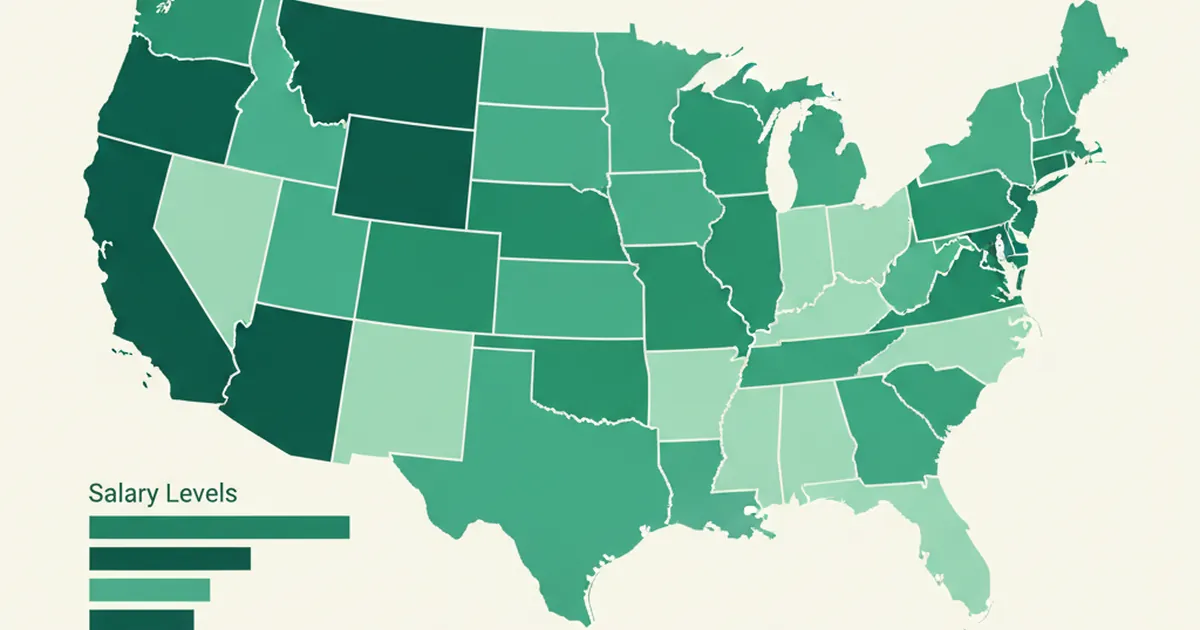
Social work salaries are usually quoted as one number — the national median of $61,780 per year, per the Bureau of Labor Statistics (May 2025). That single figure hides a spread of more than $14,000 between the highest- and lowest-paying mainline practice settings. For a BSW graduate deciding where to aim a first job, the setting you choose matters more than almost any other early-career variable you control.
Here’s what the federal wage data actually shows, and what it means for BSW-level job hunting.
Pay by Specialization: The Real Ranking
The BLS Occupational Employment and Wage Statistics program tracks social workers in distinct occupational categories. The May 2025 medians:
| Specialization | Median Annual Wage (May 2025) |
|---|---|
| Healthcare social workers | $67,880 |
| Mental health & substance abuse social workers | $60,280 |
| Child, family, and school social workers | $59,550 |
Two things stand out. First, healthcare social work pays roughly $9,500 more per year at the median than child, family, and school social work — over a 30-year career, that’s a six-figure difference before raises compound it. Second, the spread within each category is wide: in healthcare social work, the 90th percentile earns above $96,000 while the 10th percentile sits near $43,000, reflecting differences in region, employer, and experience.
Our career guides break down each path in depth: healthcare social worker, mental health social worker, substance abuse social worker, and child and family social worker.
Why Healthcare Settings Pay More
The pay gap is mostly an employer-type story, not a difficulty story. Healthcare social workers are concentrated in hospitals, home health agencies, hospice, and outpatient care centers — employers that compete for staff against the broader healthcare labor market and bill services that fund higher wages.
Child, family, and school social workers, by contrast, are employed largely by state and local government (CPS, foster care, juvenile justice) and public school districts, where salaries follow civil-service and education pay scales. The work is essential; the pay scales are compressed.
Mental health and substance abuse roles sit in between, split across outpatient clinics, residential treatment facilities, and hospitals.
What BSW Graduates Can Realistically Target
An important honesty check: some of the highest-paying healthcare social work roles — especially clinical positions in hospitals — require an MSW and licensure. But the BSW-level picture is better than commonly assumed:
- Hospital and hospice case management support, discharge planning assistance, and patient navigation roles exist at the bachelor’s level in many systems, and they sit inside the higher-paying healthcare wage structure.
- Home health and skilled nursing facilities hire BSW-level social services staff; federal nursing home regulations require qualified social workers, and BSW holders qualify in many facilities.
- Community mental health and substance abuse agencies hire BSW graduates as case managers and care coordinators, particularly where state licensure recognizes bachelor’s-level practice — check your state on our licensure guide.
Entry-level BSW positions across settings typically start in the high-$30,000s to mid-$40,000s, converging toward the medians above with experience. Location shifts everything — the same title can pay 40% differently across states, which we map in our salary-by-state breakdown.
The Career-Math Takeaways
- Aim your field placement at your target setting. Hospitals hire from their intern pools. If healthcare pay is the goal, a medical placement in your BSW field education is worth more than any elective.
- The BSW→MSW decision changes the ceiling, not the floor. The highest-paying clinical and supervisory roles require an MSW; the Advanced Standing pathway gets BSW graduates there in one year instead of two.
- Growth is solid everywhere. BLS projects employment growth of 3.4% to 9.7% between 2024 and 2034 depending on specialization — fastest for mental health and substance abuse social work, slowest for child, family, and school — so the choice between settings is about pay and fit, not job security.
- Public-sector pay is lower but not strictly worse. Government child welfare roles bring pensions, loan forgiveness eligibility, and — through Title IV-E stipend programs — sometimes a subsidized degree. Total compensation gaps are smaller than salary gaps.
If you’re still choosing a program, start where the outcomes are strongest for the money: our most affordable BSW rankings and best BSW colleges compare all accredited programs on real federal data.
Sources
- U.S. Bureau of Labor Statistics — Occupational Outlook Handbook — “Social Workers” — May 2025 wage data — https://www.bls.gov/ooh/community-and-social-service/social-workers.htm
- U.S. Bureau of Labor Statistics — Occupational Employment and Wage Statistics (OEWS) — May 2025 national tables — https://www.bls.gov/oes/tables.htm
- U.S. Bureau of Labor Statistics — “Occupational Employment and Wages” news release — https://www.bls.gov/news.release/pdf/ocwage.pdf