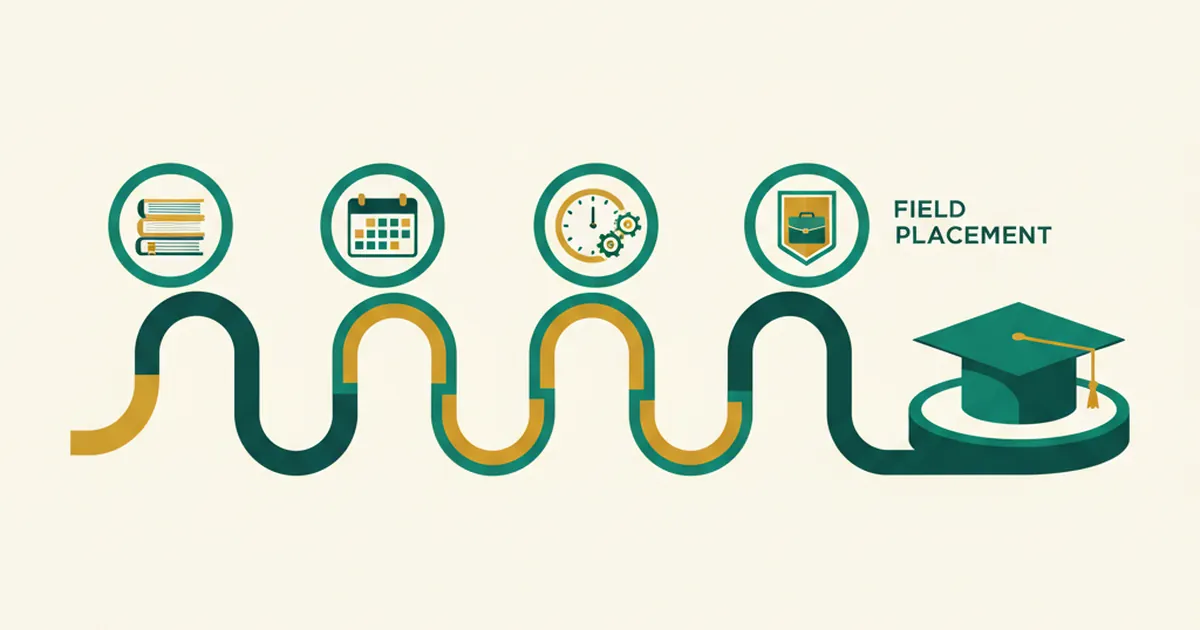
The short answer is four years. The real answer depends on where you’re starting, how many credits you’re bringing with you, whether you enroll full-time or part-time, and how your program structures its field placement. A student transferring from community college with an associate degree can finish in two years. A working parent enrolled part-time may need five or six. An accelerated track can compress the standard timeline to three.
Each of these paths leads to the same CSWE-accredited degree, and each carries its own tradeoffs in cost, intensity, and scheduling. Here is what the timeline actually looks like for every common scenario.
The Standard Timeline: 4 Years Full-Time
A full-time BSW requires approximately 120 semester credits. The first two years cover general education — English composition, introductory psychology, sociology, biology, statistics, and humanities — while the final two years focus on the social work major: human behavior and the social environment, social welfare policy, practice methods, research, and supervised field experience.
The Council on Social Work Education (CSWE) requires every accredited BSW program to include a minimum of 400 hours of supervised field experience. This practicum is the most structurally rigid part of the degree — it cannot be shortened, waived, or replaced by coursework. It typically occupies the final year and runs alongside your remaining courses.
There are currently 374 accredited BSW programs in the United States, enrolling approximately 39,647 students. More than three-quarters of those students are enrolled full-time, which means the four-year path is by far the most common. For a detailed look at what you’ll study in those four years, see our BSW curriculum overview.
The four-year timeline assumes you start as a freshman, take a standard course load each semester (15 credits), don’t fail or withdraw from courses, and enter the social work major on schedule. Any deviation — a semester off, a failed prerequisite, a late major declaration — can push graduation back.
Transfer Students: 2-3 Years
The community college-to-BSW pipeline is one of the most cost-effective routes into social work. Students who complete an associate degree (roughly 60 credits) at a community college can transfer into a BSW program as juniors and finish in approximately two years.
The key constraint: CSWE-mandated field placement hours cannot be waived or transferred. Even if you completed a human services practicum at your community college, it does not count toward the BSW field requirement. Social work core courses — practice methods, policy, human behavior, research — must also be taken at the accredited BSW program. What transfers cleanly is general education: composition, psychology, sociology, statistics, biology, and humanities.
The strongest transfer outcomes come from students who follow formal articulation agreements — contracts between a community college and a university specifying exactly which courses transfer and how they count. Without an agreement, credit evaluation happens course-by-course, and students routinely lose credits to misalignment. We cover this pathway in depth, including specific university partnerships and how to protect your credits, in our guide on community college to BSW transfer pathways.
Students transferring without a full associate degree — say, with 30-45 credits — typically need 2.5 to 3 years to finish, depending on how many prerequisites still need to be completed before entering the social work sequence.
Part-Time Students: 5-6 Years
Many BSW programs offer part-time tracks designed for students who work or have family obligations. Taking two or three courses per semester instead of five extends the timeline to five or six years, but spreads the financial and time commitment more manageably.
The biggest challenge for part-time students is field placement. The 400-hour requirement doesn’t scale down — you still need to complete all 400 hours, and most field agencies expect consistent weekly attendance. At 16 hours per week, that’s a 25-week commitment during your final year. At 8 hours per week (a more realistic part-time pace), it stretches to nearly 50 weeks, which may span more than one academic term.
Some programs accommodate this by offering evening or weekend field placements, splitting the practicum across three semesters instead of two, or partnering with agencies that have flexible scheduling. If you’re planning to go part-time, ask programs specifically how they handle field placement logistics for part-time students before you enroll. Not every program makes it workable.
Online BSW Programs
Online BSW programs follow the same credit requirements, accreditation standards, and curriculum as in-person programs. CSWE does not distinguish between delivery formats — an online BSW from an accredited program carries the same credential as one earned on campus.
The timeline for online programs is typically four years full-time, mirroring the traditional path. The difference is scheduling flexibility: asynchronous coursework lets students complete lectures and assignments on their own schedule, which can help working students maintain full-time enrollment without being locked into a class meeting time.
The 400-hour field placement is still required and still must be completed in person. Online programs arrange placements with agencies in your local area, so you do not need to relocate to the university’s city. This is one of the genuine advantages of the online format — you can earn the degree from anywhere while completing field work in your own community.
For a detailed comparison of what works and what doesn’t in online versus campus programs, see our guide on online vs. in-person BSW programs.
What Takes the Most Time: Field Placement
Field placement is the single largest block of structured time in the BSW and the component most likely to affect your graduation date. The CSWE minimum is 400 hours of supervised field experience, though some programs require more.
At a typical pace of 16 hours per week, the practicum takes about 25 weeks — essentially a full academic year. Most programs place students in the field during the senior year, with concurrent enrollment in a field seminar course where you process your experiences, connect practice to theory, and receive faculty supervision alongside your agency supervisor.
Programs structure field placement in two main ways. The concurrent model spreads hours across two semesters: you’re in the field two or three days per week while taking classes on the remaining days. The block placement model concentrates hours into one semester of near-full-time field work. Both approaches total the same hours; the choice depends on the program and sometimes on the student’s preference.
Field placement cannot be rushed. Agencies need to orient you, assign you a caseload or project, and provide regular supervision. Compressing 400 hours into fewer than 20 weeks is uncommon and generally not in the student’s interest. If anything delays your entry into the field sequence — missing a prerequisite, a GPA shortfall, a late application to the field office — your graduation date moves with it. For a detailed walkthrough of what the practicum involves, see our guide on what to expect in your social work field placement.
The BSW-to-MSW Fast Track
One of the most significant timeline advantages of earning a BSW is access to advanced standing MSW programs. These programs recognize that BSW graduates have already completed foundational social work coursework and field experience, allowing them to skip the first year of the MSW and complete the master’s degree in approximately one year instead of two.
The result: a student who earns a BSW in four years and immediately enters an advanced standing MSW can hold a master’s degree in five years total. A student who earns a bachelor’s degree in another field — psychology, sociology, political science — and then pursues an MSW needs at least six years (four for the bachelor’s plus two for the full MSW). That one-year difference translates to a full year of earlier entry into the workforce at MSW-level salary, plus one fewer year of tuition and living expenses.
CSWE’s guidance on advanced standing confirms that these programs are available to graduates of CSWE-accredited BSW programs who meet the receiving program’s GPA and application requirements. Not every MSW program offers advanced standing, but the majority do.
If you’re considering whether the master’s degree is worth pursuing after a BSW, we break down the career and salary implications in our comparison of BSW vs. MSW.
Timeline Summary
| Path | Total Time | Credits | Notes |
|---|---|---|---|
| Traditional full-time | 4 years | ~120 | Standard path, includes 400-hour field placement |
| Transfer (with associate degree) | ~2 years | ~60 remaining | Must complete social work core + field at BSW program |
| Part-time | 5-6 years | ~120 | Flexible scheduling, but field placement is demanding |
| Accelerated | 3-3.5 years | ~120 | Summer terms required, limited program availability |
| BSW + Advanced Standing MSW | 5 years total | ~150-160 | Fastest path to master’s-level practice |
The right timeline depends on your circumstances — your finances, your work schedule, your family obligations, and whether you’re entering as a freshman or transferring credits. What doesn’t change across any of these paths is the accreditation standard: 400 hours of field experience, the same core curriculum, and the same professional credential at the end.
If you’re ready to start narrowing down programs, our program selection guide walks through what to look for, and our overview of how to choose a CSWE-accredited BSW program covers the accreditation details that matter most.
Sources
- Council on Social Work Education — “Social Work at a Glance” — https://www.cswe.org/students/prepare-for-your-education/social-work-at-a-glance/
- CSWE — “2023-2024 Annual Survey of Social Work Programs” — https://www.cswe.org/getmedia/4987f514-0b71-48b9-9951-890a4060de29/2023-2024-Annual-Survey-of-Social-Work-Programs.pdf
- CSWE — “Student Questions (FAQ)” — https://www.cswe.org/about-cswe/faqs/student-questions/